Kenyan customers increasingly use Google to find products, compare service providers, check reviews and decide which business to contact.
Kenya had an estimated 23.4 million internet users by October 2025. This creates a major opportunity for businesses that appear when potential customers search for their services.
However, getting website visitors is not the final goal.
Your SEO strategy should attract people who are likely to call, send a WhatsApp message, request a quotation, book an appointment or buy from you.
Here are 15 practical SEO tips Kenyan businesses can use to generate more qualified leads.
1) Target keywords that show buying intent
A keyword can bring traffic without bringing customers.
Someone searching for “what is web design” may only be looking for information. A person searching for “web design company in Kenya” is more likely to be comparing providers.
Focus on phrases that suggest the customer is ready to take action.
Examples include:
Solar installation companies in Kenya
Apartments for sale in Kilimani
Best accountants in Nairobi
Car hire services in Mombasa
Affordable website designers in Kenya
CCTV installation company near me
Corporate event planners in Nairobi
Request an insurance quote in Kenya
Look for words such as:
Company
Services
Cost
Price
Quote
Hire
Provider
Consultant
Agency
Near me
Best
Affordable
Informational keywords still have value, especially when customers need to research before buying. However, your service and product pages should primarily target commercial searches.
2) Create a page for each important service
One broad services page rarely ranks well for every service a business offers.
Suppose a construction company provides:
House construction
Office renovations
Quantity surveying
Interior design
Project management
Placing all these services on one page gives Google limited information about each one.
Create a dedicated page for every major service instead.
For example:
/house-construction-kenya//office-renovation-nairobi//quantity-surveying-services//interior-design-kenya/
Each page should explain:
What the service includes
Who it is suitable for
Your service process
Areas you serve
Factors affecting the price
Relevant past projects
Common customer questions
How to request a quotation
Google recommends organising websites logically and creating useful content that helps people understand what a page offers.
A dedicated page also gives you a more relevant destination for Google Ads, social media campaigns and sales messages.
3) Optimise your Google Business Profile
A Google Business Profile can help your company appear in Google Maps and location-based search results.
It is particularly important for:
Restaurants
Clinics
Salons
Law firms
Repair companies
Hotels
Real estate agencies
Schools
Shops
Contractors
Professional service firms
Complete every relevant section of your profile, including:
Business name
Primary business category
Additional categories
Physical address
Service areas
Phone number
Website
Opening hours
Business description
Products and services
Photos
Use the category that most accurately describes your primary business. Avoid choosing unrelated categories simply to appear for more searches.
Your information should also remain accurate. Google states that businesses with complete and accurate information are more likely to appear in relevant local results.
Review your profile whenever your phone number, location, opening hours or services change.
4) Use location keywords naturally
Many Kenyan searches include a town, county, estate or neighbourhood.
Examples include:
Dentist in Westlands
Plumber in Kiambu
Lawyer in Nakuru
Apartments in Ruaka
Catering services in Nairobi
Hotels near Diani Beach
Moving company in Mombasa
Cleaning services in Karen
Include your real service location in important areas such as:
Page title
Main heading
Introduction
Service description
Image alternative text where relevant
Contact section
Meta description
Do not repeat the location unnaturally in every sentence.
Instead of writing:
We are a Nairobi cleaning company offering Nairobi cleaning services to Nairobi customers looking for cleaners in Nairobi.
Write:
We provide home and office cleaning services across Nairobi, including Westlands, Kilimani, Karen, Lavington and surrounding areas.
The second version is clearer and provides useful geographical information without keyword stuffing.
5) Build useful location pages
A business serving several areas may benefit from separate location pages.
For example, a pest control company could create pages for:
Pest control in Nairobi
Pest control in Kiambu
Pest control in Machakos
Pest control in Kajiado
However, changing the town name while keeping every other sentence identical creates weak pages.
Each location page should contain information specific to that area, such as:
Services available in the location
Estates or neighbourhoods covered
Typical response times
Relevant projects completed nearby
Directions or landmarks
Local customer reviews
Location-specific pricing considerations
A local phone number or branch details, where applicable
Only create a location page when you genuinely serve that area.
For businesses with a physical branch, include the correct address, opening hours and contact details. Service-area businesses can explain how customers in that location are served without inventing an office.
6) Match every page to the customer’s search intent
Search intent is the result a person expects when entering a query.
Someone searching for “office chairs Kenya” probably wants to see products. They do not want to read a 3,000-word history of office furniture.
Someone searching for “how to choose an office chair” expects advice rather than an aggressive sales page.
Before creating a page, search the target phrase and examine what currently appears.
Ask:
Are the top results service pages, product pages or articles?
Do users seem to want prices?
Are they comparing several options?
Is the search local?
Do the results contain videos, maps or product listings?
What questions do the leading pages answer?
Build the type of page that best meets the need behind the search.
A useful structure might be:
Search | Best page type |
|---|---|
Corporate lawyers in Kenya | Service or category page |
Cost of registering a company in Kenya | Detailed guide |
Buy office desks in Nairobi | Product category page |
Best payroll software in Kenya | Comparison article |
Dentist near me | Google Business Profile and location page |
Request a moving quote | Lead-generation landing page |
Matching intent improves your chances of ranking and attracting visitors who are likely to convert.
7) Write titles that attract the right clicks
Your SEO title is often the first part of your website that a potential customer sees in Google.
It should make the page topic immediately clear.
A weak title might be:
Welcome to our professional solutions
A stronger title would be:
Office cleaning services in Nairobi | Company name
Useful title formats include:
Service in location | brand
Product category in Kenya | brand
Service cost in Kenya: prices and factors
Best product or service for audience
How to solve problem in Kenya
Keep the title specific and avoid exaggerated claims that the page cannot support.
Your meta description should give the searcher a reason to visit.
For example:
Need reliable office cleaning in Nairobi? Get trained cleaners, flexible schedules and a tailored quotation for your workplace.
Google may rewrite titles and descriptions depending on the search. Even so, clear page metadata helps both search engines and users understand the page.
8) Publish content that supports your services
Blogging works best when articles are connected to what your business sells.
A real estate agency should not publish random lifestyle posts simply to increase its article count.
It could create content such as:
Cost of buying a house in Kenya
Documents needed when buying land in Kenya
Best places to live near Nairobi
Apartment service charges explained
Questions to ask a real estate agent
How mortgages work in Kenya
Buying off-plan property in Kenya
Each article can answer an early-stage question and guide interested readers towards a relevant property or service page.
A cybersecurity company might cover:
Signs that a business email has been compromised
Cybersecurity requirements for Kenyan SMEs
How much a security audit costs
How to train employees to avoid phishing
Data backup options for small businesses
Do not end articles with generic lines such as “contact us for more information.”
Use a specific next step:
Concerned about weaknesses in your company network? Request a security assessment from our team.
The article earns attention. The call to action turns that attention into a possible lead.
9) Use Kenyan examples, prices and terminology
Generic content often fails because it does not reflect the customer’s situation.
A Kenyan reader may need information about:
Prices in Kenyan shillings
M-PESA payments
Kenyan laws and regulators
Local delivery areas
County permits
Local banks and payment providers
Common business practices
Kenyan climate and infrastructure
Locally available products
Local market conditions
For example, an article about starting an online shop should discuss payment methods customers actually use in Kenya. A guide about installing solar power should reflect local electricity costs, sunshine conditions and available equipment.
Original local knowledge helps your content stand apart from articles written for a broad global audience.
Include firsthand information such as:
Quotes from your specialists
Real project examples
Before-and-after results
Local customer questions
Original photographs
Price ranges
Lessons from completed work
Relevant Kenyan data
Do not copy statistics from another article without checking the original source.
10) Add strong calls to action
Ranking first has limited business value when visitors cannot work out what to do next.
Every important page should have a clear conversion action.
Possible calls to action include:
Request a quotation
Book a consultation
Call our team
View available properties
Order through WhatsApp
Schedule an inspection
Check availability
Get a free assessment
Compare packages
Match the action to the page.
A visitor reading about wedding photography may be ready to check date availability. A visitor reading an introductory accounting guide may prefer to request a consultation.
Place the primary call to action:
Near the top of the page
After important explanations
Near prices or packages
At the end of the page
Avoid displaying five equally prominent buttons. Choose one main action and use secondary options only when necessary.
11) Make your website easy to use on mobile phones
Many customers will first encounter your website on a phone.
A mobile-friendly website should not require visitors to:
Zoom in to read text
Close several pop-ups
Scroll sideways
Search for your phone number
Complete unnecessarily long forms
Wait for large images to load
Tap tiny buttons
Test your most important pages on an actual smartphone.
Check that:
Text is easy to read
Menus work correctly
Buttons are easy to tap
Forms are short
Phone links open the dialler
WhatsApp links open the correct conversation
Images fit the screen
Important information appears early
Mobile usability affects more than rankings. It affects the number of visitors who stay long enough to contact you.
12) Improve website speed
A slow website can lose a lead before the customer sees your offer.
Common causes of poor performance include:
Oversized images
Cheap or overloaded hosting
Too many WordPress plugins
Heavy page builders
Autoplaying videos
Unnecessary tracking scripts
Poor caching
Large custom fonts
Outdated themes
Start with your highest-value pages rather than trying to fix everything at once.
Compress images, remove unused plugins, enable caching and avoid loading video backgrounds on mobile devices.
A beautiful homepage that takes too long to open is less useful than a simple page that quickly communicates what you offer.
Speed improvements should preserve important content and functions. Do not remove contact forms, product details or helpful images simply to obtain a perfect test score.
13) Earn relevant Kenyan backlinks
A backlink is a link from another website to yours.
Quality backlinks can help search engines discover your pages and evaluate your website’s authority. The most useful links tend to come from websites connected to your industry, location or professional relationships.
Possible sources include:
Industry associations
Business partners
Suppliers
Professional directories
Local news publications
Event websites
Universities and training institutions
Chambers of commerce
Community organisations
Clients that feature their suppliers
Podcasts and industry interviews
You could earn a link by:
Publishing original research
Providing expert commentary
Sponsoring a relevant event
Creating a useful free tool
Contributing a well-researched guest article
Publishing an industry report
Partnering with another organisation
Offering a strong customer success story
Avoid buying hundreds of low-quality links from unrelated websites. These links rarely bring customers and may create long-term SEO problems.
One relevant link from a respected Kenyan industry website may be more useful than dozens of links from unknown directories.
14) Ask customers for genuine Google reviews
Reviews can influence both local visibility and customer trust.
Google says local results are mainly based on relevance, distance and prominence. The number of reviews and review scores can contribute to a business’s local prominence.
Ask satisfied customers to leave an honest review after:
Completing a project
Delivering an order
Resolving a support request
Finishing an appointment
Reaching an important result
Make the process easy by sending customers your direct review link through email, SMS or WhatsApp.
Do not tell every customer what exact words to use. However, you can ask them to describe the service they received and their experience.
Respond professionally to positive and negative reviews.
A useful response can mention the service naturally:
Thank you for choosing our team for your office relocation in Nairobi. We are glad the move went smoothly.
Do not create fake reviews, pay for positive ratings or ask employees to impersonate customers.
15) Measure leads, not rankings alone
Rankings can help diagnose performance, but they do not tell the full business story.
A page may rank well and generate no enquiries. Another page may attract fewer visitors but produce several valuable leads.
Track actions such as:
Contact form submissions
Phone number clicks
WhatsApp button clicks
Email clicks
Quote requests
Appointment bookings
Product purchases
Downloads
Directions requests
Use Google Search Console to identify:
Queries bringing visitors
Pages receiving impressions
Average search positions
Changes in organic clicks
Pages that Google has indexed
Use an analytics platform to understand what visitors do after arriving.
Review performance by page and service. This will help you see which parts of your SEO strategy produce genuine business opportunities.
A simple monthly report could include:
Metric | What it tells you |
|---|---|
Organic clicks | How many visits came from search |
Qualified enquiries | How many relevant leads SEO produced |
Conversion rate | How efficiently traffic becomes leads |
Cost per lead | How SEO investment compares with results |
Top landing pages | Which pages attract potential customers |
Lead source | Which search, page or campaign influenced the enquiry |
Sales value | How much revenue came from organic leads |
The most important SEO question is not, “How many keywords are we ranking for?”
It is:
Is organic search helping the business attract the right customers and generate revenue?
Start with the pages closest to a sale
You do not need to implement all 15 SEO tips at once.
Begin with the pages most likely to generate leads:
Your homepage
Your main service pages
Your product or category pages
Your location pages
Your contact or quotation page
Your Google Business Profile
Make sure these pages clearly state what you offer, who you serve, where you operate and what the customer should do next.
After strengthening these pages, create supporting articles, build relevant links and improve weaker technical areas.
SEO takes consistent work, but the result should be more than higher traffic. A successful strategy places your business in front of Kenyan customers who are actively searching for the products or services you provide.
Get an SEO strategy built around leads
Your business does not need more meaningless website traffic. It needs visibility for the searches that can turn into enquiries, customers and revenue.
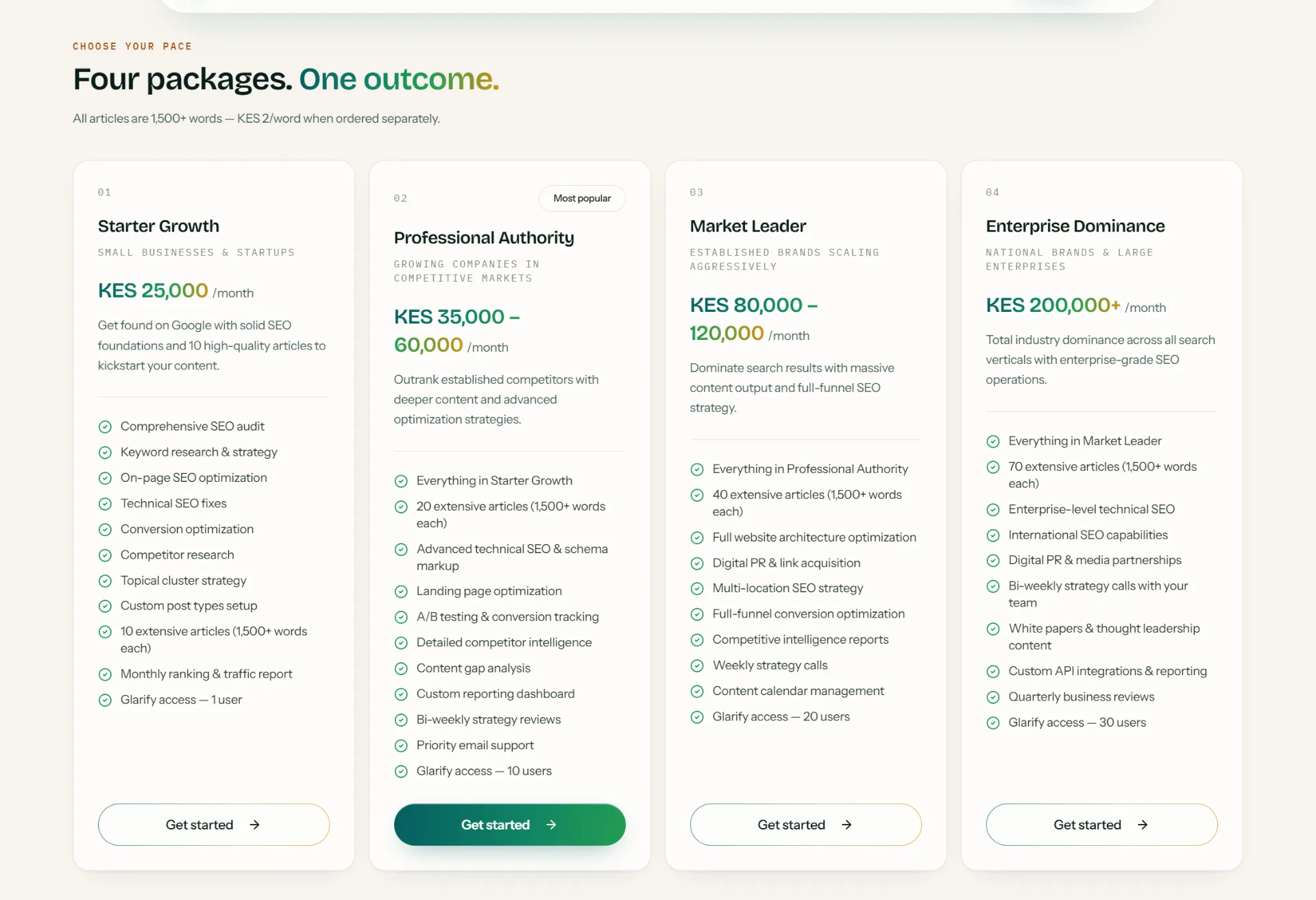
Amplify SEO helps Kenyan businesses improve their search visibility, strengthen their websites and turn organic traffic into qualified leads.
Let's Do SEO for You